The Romans and their snails
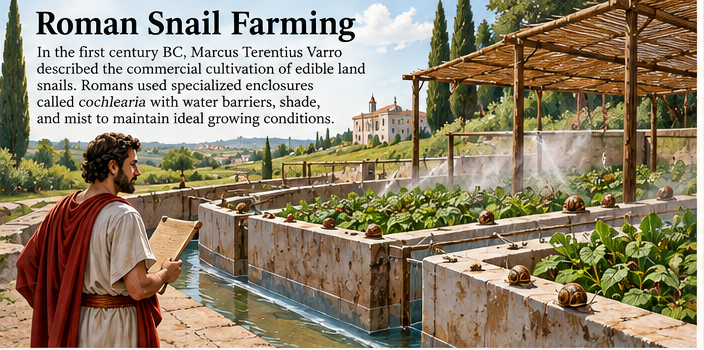
More than two thousand years ago, Roman farmers were experimenting with an agricultural idea that remains relevant today: the conditions under which an organism lives in nature are not necessarily the conditions under which it will be most productive in cultivation. One of the more entertaining examples comes from snail farming.
In the first century BC, Marcus Terentius Varro described commercial land-snail cultivation in De Re Rustica, Book III. Specialized enclosures, sometimes called cochlearia, managed moisture and prevented escape. Pliny the Elder later credited Fulvius Lippinus with establishing specialized operations near Tarquinii in central Italy and maintaining different kinds of snails from various regions.
Varro also described fattening snails with spelt and grape must. Rather than depending solely on what snails encountered in the wild, Roman farmers supplied concentrated agricultural feed. They were not doing modern experimental science, but they understood that nutrition and environment could be actively managed for agricultural results.
Nature is not necessarily the optimum
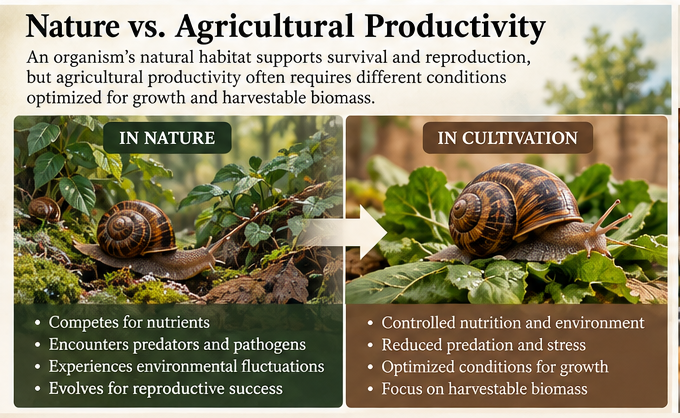
An organism’s natural habitat tells us where it has evolved to survive, compete, and reproduce. It does not tell us which conditions maximize harvestable food production. In the wild, organisms cope with limited nutrients, changing weather, competitors, and pathogens. Natural selection favors reproductive success in that setting, not necessarily high farm yields.
Agriculture changes those constraints. Livestock feed is formulated for nutrients, not just to recreate an ancestral diet. The biological details differ profoundly for fungi, which digest substrates extracellularly, but the agricultural question is analogous: how do we identify the environment that best supports a desired productive outcome?
What happens when we stop treating an organism’s natural habitat as a fixed cultivation prescription and begin treating nutrition, environment, and production methods as variables to be measured?
From natural substrates to engineered substrates
Many mushrooms are cultivated on materials resembling their ecological food sources: sawdust for wood-decaying fungi, compost for certain other species. These choices are well-founded and successful, but they need not be exclusive. Pleurotus eryngii is naturally associated with roots and dying tissues of herbaceous plants, including certain Apiaceae. Commercial growers nevertheless produce it on supplemented agricultural substrates very different from those found in the wild.
This suggests a change of emphasis. Instead of asking which natural material a cultivated fungus resembles, we can ask which measurable nutritional, chemical, and physical properties support growth and fruiting. Natural history supplies valuable hypotheses; it should not be treated as an inflexible recipe.
Whole oats and direct-injection fruiting bags

Conventionally, grain is colonized as spawn and then transferred to a larger fruiting substrate. That requires preparation, sterilization, inoculation, incubation, transfer, and further colonization. Each stage consumes time and introduces additional handling.
My experiments examine whether whole oats can remain a principal component of the final fruiting substrate. One formulation is DIFB70 — Direct Injection Fruiting Bag, 70% Grain, with about 70% whole oats and 30% oak sawdust by dry ingredient weight. Liquid culture is injected directly into the prepared final bag, with the aim of colonizing and fruiting without a separate grain-to-bulk transfer.
Early observation of vigorous colonization is encouraging, but this alone does not demonstrate productive fruiting. Fresh yield, biological efficiency, contamination frequency, and total production time must be measured before drawing conclusions.
Carbon-to-nitrogen ratio: necessary, not sufficient
Carbon supports fungal energy metabolism and cell construction; nitrogen is required for proteins, enzymes, nucleic acids, and other molecules. The carbon-to-nitrogen ratio (C/N) describes their relative amounts and is a useful starting point for substrate design.
Yet identical C/N ratios can conceal very different materials. Whole oats provide substantial starch, protein, and fat. Oak sawdust contributes cellulose, hemicellulose, and lignin. The chemical accessibility of these nutrients, not only their elemental totals, determines how the fungus can use them. Grain and sawdust also differ in texture, water retention, and gas-exchange properties.
Thus a C/N target should be tested across formulations rather than treated as a guaranteed optimum. Fast colonization may occur under conditions that do not give the highest fruiting yield. Carbon in calcium carbonate is inorganic carbonate carbon and should not be counted as metabolically available organic carbon in a nutritional C/N calculation.
Calcium carbonate: pH and buffering
Calcium carbonate (CaCO₃) can neutralize acids, influence the starting pH, and provide buffering capacity during fungal metabolism. It also supplies calcium. Calcareous habitats associated with some Cardoncello populations make this chemistry interesting, but native limestone soils do not prove that any given CaCO₃ dose will improve a cultivated substrate.
The question is experimental: what initial pH and buffer capacity improve colonization and fruiting? Measurements of starting pH, pH changes, development, and yield are more informative than an inherited percentage alone. Effects attributable to pH should be distinguished from calcium nutrition.
Gypsum: calcium, sulfur, and structure
Gypsum (CaSO₄·2H₂O) provides calcium and sulfur without functioning as a strong alkaline buffer. Sulfur contributes to amino acids and other essential molecules; gypsum may also affect handling and physical properties in some formulas.
CaCO₃ and gypsum therefore are not interchangeable. A meaningful experiment holds the grain-to-sawdust ratio constant and compares different mineral treatments. Tests of gypsum should consider the existing sulfur and calcium supplied by other ingredients, rather than assuming an addition is automatically beneficial.
From inherited recipes to measurable formulations
A conventional recipe specifies percentages of oats, sawdust, bran, lime, or gypsum. Such recipes are practical, but raw materials vary. A more reproducible method would first set targets for nutritional balance, initial pH, buffer capacity, calcium and sulfur contributions, hydration, particle structure, and gas exchange, then select ingredients to achieve those targets.
In this framework, a 70/30 oats-and-sawdust mixture is not a conclusion: it is a baseline. A trial can ask whether changing C/N ratio or mineral chemistry improves one outcome without worsening another. Factorial or carefully staged comparisons can help distinguish ingredients’ effects from interactions among them.
Substrate engineering does not mean every relevant property is reducible to a single number. It means treating the principal variables as testable instead of accepting a formula simply because it is familiar.
Colonization is not production
The commercial goal is harvestable mushrooms, not merely white, vigorous substrate. Fruiting is a distinct developmental stage. A mixture that colonizes quickly can still produce disappointing yields; a slower treatment might deliver greater biological efficiency or better reliability.
Evaluation should follow each bag through harvest and record colonization duration, pinning and harvest dates, wet yield, biological efficiency based on initial dry substrate, contamination, inputs, sterilization energy, and handling time. A somewhat lower-yielding one-step bag might prove economically attractive if it consistently saves substantial labor and calendar time; that, too, must be established by measurement.
An ancient idea and a modern research question
The Roman snail farmers did not calculate fungal C/N ratios or compare calcium carbonate with gypsum. Snails ingest feed while fungi absorb products of extracellular digestion, so the comparison is a historical analogy, not experimental evidence for grain-fed mushrooms.
What joins the stories is a willingness to examine the organism’s productive potential rather than making its wild environment a fixed prescription. For my work with Pleurotus eryngii, the questions remain open: can a grain-rich substrate be balanced for dependable fruiting? Can calcium carbonate and gypsum produce measurable improvements? Can direct inoculation simplify production without compromising yield or consistency?
Nature tells us where an organism has succeeded in surviving. It does not necessarily tell us the limits of what that organism can achieve under cultivation.
The purpose of agricultural experimentation is to investigate those limits—using nature as a guide, but measurement as the test.
Historical sources and further reading
- Varro, De Re Rustica, Book III, Chapter 14 — snail husbandry and fattening practices.
- Pliny the Elder, Natural History, Book IX — Fulvius Lippinus and Roman snail enclosures.
This article presents research questions and experimental hypotheses; it does not claim that grain-rich substrates or specific mineral additions have been proven superior.